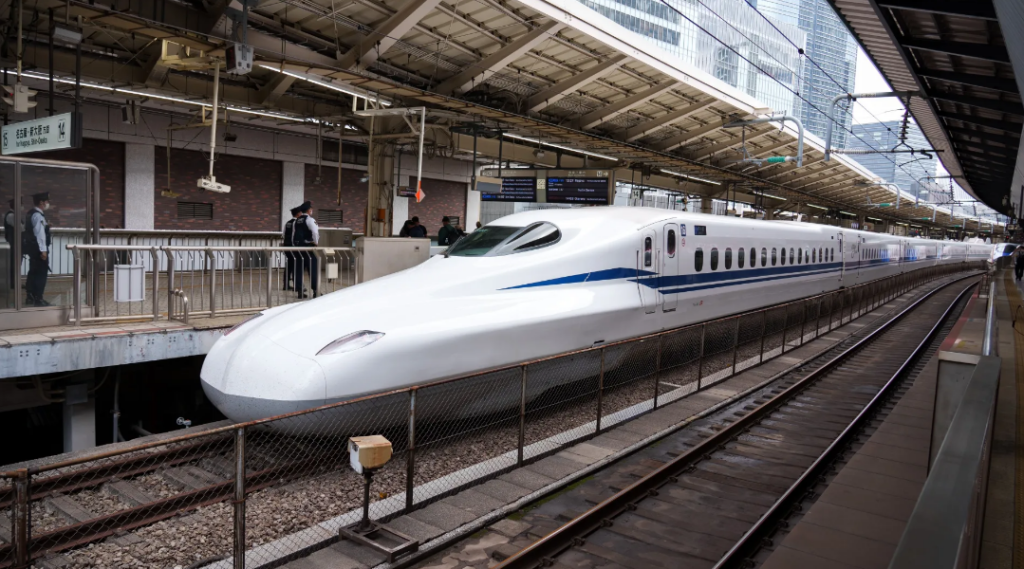
In 1964, after World War II, Japan’s technological innovation marked the nation’s return to the global stage. On the early morning of October 1, 1964, a sleek blue and white train glided through Tokyo’s outskirts, heading south to Osaka. This was the beginning of the bullet train era in Japan, symbolizing the country’s remarkable post-war resurgence.
Coinciding with the 1964 Tokyo Olympics, this marvel of 1960s technology signified Japan’s re-entry onto the international scene.
Over the past six decades, the word “Shinkansen” — meaning bullet train in Japanese — has become globally synonymous with speed, efficiency, and modernity.
Japan remains a leader in rail technology. Major conglomerates like Hitachi and Toshiba export billions of dollars in trains and equipment worldwide each year.
Since the opening of the 515 km Tokaido line between Tokyo and Shin-Osaka in 1964, the Shinkansen network has steadily expanded. Today, trains reaching speeds of up to 320 km/h connect cities from Tokyo in all directions — north, south, and west — including Kobe, Kyoto, Hiroshima, and Nagano.
The Shinkansen is more than just a symbol of recovery; it is also a key driver of Japan’s continued economic development, reshaping a country steeped in tradition.
Breaking Barriers The development of the Shinkansen owes much to Japan’s rail history. Unlike the standard gauge of 1435 mm used in North America and much of Europe, Japan opted for a narrower gauge of 1067 mm. While this made construction easier in mountainous terrain, it limited capacity and reduced speeds.
Stretching over 3,000 km from end to end, Japan’s four main islands had long, exhausting travel times between major cities.
By 1889, a train journey from Tokyo to Osaka took 16 and a half hours — a vast improvement from the two-to-three-week journey by foot only years earlier. In 1965, the Shinkansen reduced this time to just three hours and 10 minutes.
The demand for a “standard gauge” rail network began in the early 20th century, but work only started in the 1940s. This was part of an ambitious plan to connect Japan to Korea and Russia through tunnels under the Pacific Ocean.
World War II’s defeat delayed these plans until the 1950s when Japan’s rapidly recovering economy made communication between its major cities crucial.
While much of the network serves Honshu, Japan’s largest island, long undersea tunnels allow bullet trains to run hundreds of kilometers to Kyushu in the south and Hokkaido in the north.
Japan’s challenging topography and varied climate — from the cold northern regions to the tropical south — have made Japanese engineers global leaders in solving unique problems and pushing the boundaries of rail technology.
Among the most notable challenges are earthquakes. Japan is one of the world’s most geologically unstable countries, prone to earthquakes, tsunamis, and home to about 10% of the world’s active volcanoes.
Despite these dangers, no passenger has ever died or been injured in a Shinkansen derailment.
Japan’s Railway Revolution The next generation of bullet trains, known as ALFA-X, is being tested at speeds approaching 400 km/h, although the top operating speed will be “just” 360 km/h.
These new trains feature cutting-edge designs, with elongated noses not only improving aerodynamics but also eliminating the “sonic booms” caused by air pressure when entering tunnels — a significant issue in densely populated areas.
Additionally, the experimental ALFA-X train incorporates new safety technologies to reduce vibrations and noise and minimize derailments during major earthquakes.
Over 10 billion passengers have traveled with comfort and reliability on Shinkansen trains, making high-speed rail a routine, practically guaranteed experience.
High-Speed Rail Around the World In 2022, more than 295 million people traveled on Shinkansen trains throughout Japan. It’s no surprise that many other countries have followed Japan’s lead, building their own high-speed railways over the last four decades.
Perhaps the most famous example is France, which has operated the TGV (Train à Grande Vitesse) between Paris and Lyon since 1981.
Like Japan, France has exported its technology to other countries, including Spain, Belgium, South Korea, the United Kingdom, and Morocco, which opened Africa’s first high-speed rail line.
The future of rail travel looks bright, with the Shinkansen evolving and new projects emerging globally. This may well usher in a new golden era for railways in a world increasingly concerned with the environmental impact of air travel.